 11
11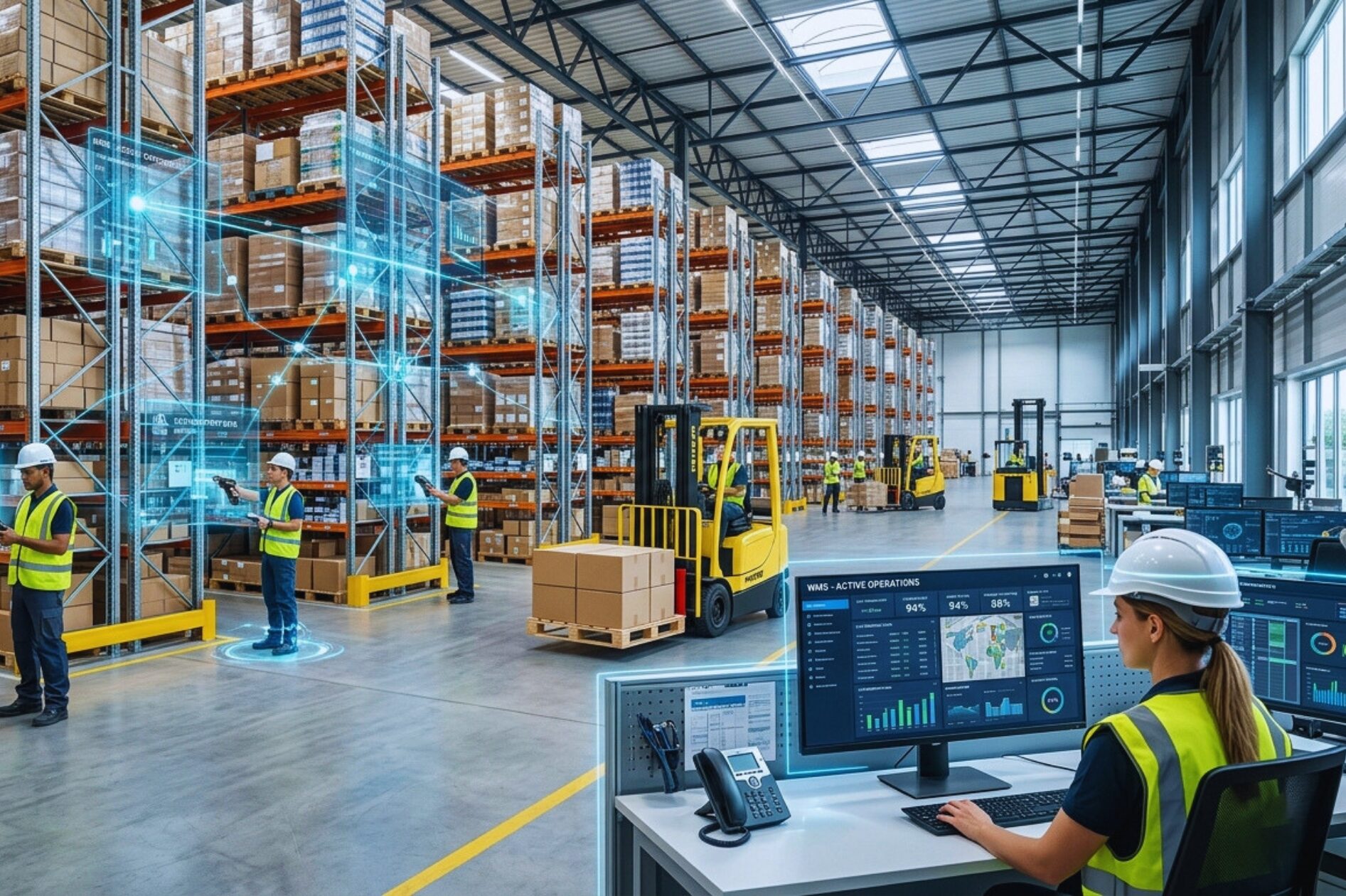
For companies that deal with inventory, orders, shipments and multiple locations, warehousing is a vital part of the business process.For businesses that manage inventory, orders, shipments, and multiple locations, efficient warehouse management is essential.
Companies are challenged by order processing times being reduced, accurate stock information, and improved warehouse processes. Small companies can use manual methods and traditional spreadsheets, but they can become cumbersome to manage as inventory grows. This is where a Warehouse Management System or a WMS system comes in handy.
A WMS system is created to handle, automate and optimize crucial warehouse processes, such as receiving materials, stocking inventory, picking orders, packing products, and producing shipping to clients. This centralization of these activities in a digital platform can help companies enhance accuracy, cut down on operational expenses, boost productivity, and make informed decisions.
A modern WMS system can also communicate with ERP, ecommerce, TMS, barcode scanners, RFID, and more. The right warehouse management technology can give a business a competitive edge when it comes to having a more organized and efficient supply chain.
The process of a Warehouse Management System is to computerize the movement and storage of products through a Warehouse. On arrival, staff can use a barcode scanner, RFID or other data capture system to record the new products. The system can then seek to determine the best place to store products based on the product type, warehouse space, demand and warehouse layout.
If an order comes in, the WMS System can issue picking instructions to suggest where to place the contents of the order. Products may be picked, packed and shipped while the inventory is updated automatically. This establishes a seamless process where warehouse personnel can have reliable information throughout the process.
Additionally, a lot of contemporary systems can offer live visibility of inventory levels, order status, warehouse actions, and staff productivity. By automating these processes, businesses can minimize unnecessary manual work and create a more consistent approach to warehouse operations.
Warehouses have numerous interdependent tasks to perform that need to be performed properly and effectively; this is where a WMS system becomes crucial. Inaccurate record keeping, late deliveries, extra labour expenses or customer dissatisfaction can result from a simple mistake relating to receiving, storage, picking or dispatch.
A WMS offers a structured system for handling such activities and aids workers to adhere to structured processes. Warehouse personnel can access and use shared digital data instead of relying on cumbersome paper documentation or having to manually update spreadsheets.
The system could give managers more insight into the goings-on at the facility and assist managers in identifying operational issues at an earlier time. Warehouse information can also be used to gain insights into demand trends, measure performance, and optimize resource planning in business. The more complex the activities in the warehouse, the more important it is to have a reliable system to coordinate the activities.
One of the biggest benefits of implementing a WMS system is inventory accuracy. It is important for businesses to be aware of the quantity of their stock, the location of their products, and which ones are in demand for customers. When inventory data is wrong, it can lead to stock outs, overstocks, late orders, and over-purchasing. A WMS System can be used to keep inventory records up-to-date when products are received, moved, picked, packed, returned, and shipped. Manual data-entry errors can be further minimized with the help of barcode scanning and the RFIDs.
Handheld devices can be used by employees to verify products and storage areas when working in the warehouse. A further feature of some systems is that cycle counting is possible, which means that companies can regularly check selected inventory without having to completely stop warehouse activities. Having more visibility of inventory allows companies to keep the correct amount of stock on hand and to be able to respond faster to customer demand.
Order picking can be one of the most time consuming tasks in a warehouse, especially if staff are required to manually look for the products. A WMS System can help with this process by giving optimal picking instructions. Single order picking, batch picking, zone picking and wave picking are some of the strategies that can be employed depending on the needs of the system and warehouse.
The software can identify the route to the warehouse which is most efficient, thus reducing the time spent by employees to walk between different locations. Picking instructions also can be used to assist workers in confirming product details prior to the item being picked.
These are functions that help to minimize picking mistakes and speed up order fulfillment. Certain ecommerce companies, retailers, distributors and others who receive many orders from customers on a daily basis may find it beneficial to pick orders more rapidly and correctly.
A WMS system can help to boost the efficiency of labor, storage space, and inventory management, thereby helping businesses to cut down on their operating costs. Improved visibility of inventory can prevent over ordering and loss of products due to stock outages or product obsolescence. Optimizing picking routes can help to minimize movement time employees spend around the facility.
Automated workflows can also help to streamline administrative processes and minimize repetitive manual data entry. Moreover, the system can provide reports that warehouse managers can use to identify inefficiencies, bottlenecks and unused resources. With time, all these enhancements can lead to reduced work prices and improved warehouse space utilization. While a WMS system is an initial investment, when correctly chosen and executed, a WMS can provide long-term value due to the efficiencies it brings to operations.
Warehouse space can be costly and an inefficient inventory storage system can restrict the number of products that a business will be able to store. A WMS System can help organizations to utilize available space more effectively, by giving them visibility on where stock is stored and where it is moving.
Based on the system’s capability, it can suggest suitable storage locations for products according to multiple factors including product size, demand, storage needs, and space availability. Convenient locations can be used for frequently ordered products which reduces picking time, and less frequently ordered products can be placed in less convenient locations.
Improved location management also makes it more convenient for staff to locate products when they are required. When inventory is organized more efficiently, businesses can benefit by being able to fit more inventory into their storage space without having to expand the square footage of the warehouse.
Customers have come to expect timely and error-free processing of their orders. A WMS streamlines the flow of warehouse operations, which in turn can aid in orders being fulfilled faster. After the order is added to the system, picking and packing instructions can be sent to the warehouse workers, eliminating the need for manual tasks.
Product verification can help to minimise error before products are sent to customers, while real-time inventory management can help to ensure businesses don’t take orders for products that are currently out of stock. The system can also offer warehouse managers visibility of order progress, and detect delays.
Quick fulfillment can boost consumer fulfillment, which subsequently can aid organizations meet their delivery commitments. These enhancements can significantly influence business operations and customer satisfaction for businesses with larger orders.
Automation plays an integral role in warehouse management today. A WMS System can streamline numerous mundane tasks such as inventory management, task assignment, reorder alerts, reporting, and order processing. In more advanced warehouse settings, WMS could be integrated with ASRS, conveyors, AMRs (autonomous mobile robots), sortation equipment, and other warehouse equipment.
Automation doesn’t automatically mean that people won’t play a role. Rather, it can assist workers to concentrate on tasks that demand judgment and technology to handle repetitive tasks. With the help of software automation, companies can build quicker and more streamlined workflows by incorporating warehouse equipment. It greatly relies on the factors including order volume, warehouse size, product attributes, budget, and business goals in the long term.
Correct information plays a key role in successful warehouse decisions. A WMS can track warehouse data on picking performance, receiving activities, inventory movement, order processing, storage utilization, and more. This data can be accessed as dashboards or reports for managers to review and learn about how things are going and what they can do to make them better.
If certain warehouse zones are regularly underperforming, managers can address the problem by exploring the root cause and make changes in staffing and/or storage arrangements. Likewise, inventory data can aid companies determine which items are moving slowly and make better purchasing decisions. Real-time operational data means managers can shed guesswork and make decisions based on the real warehouse performance. This information, combined with data-driven decision-making, can help facilitate continuous improvement and long-term planning.
A WMS system can be integrated with other business applications and technologies. A lot of companies rely on various applications for accounting, enterprise resource planning, e-commerce, customer relations management, transportation management and ordering. When these systems are independent, it can mean employees have to input the same data in more than one place which raises the risk of error.
A WMS can be integrated with the relevant systems, allowing for seamless flow of important information across platforms. For instance, if a customer places an order online, it could be passed on to the warehouse for fulfillment, and inventory updates could be pushed back to the online store. Integration provides a more integrated business environment and can help to have more consistent information in the departments.
The advantages of a WMS are more than just inventory tracking. Businesses can benefit from increased inventory accuracy, order processing speed, better warehouse organization, decreased picking errors, increased labor productivity, and a greater understanding of warehouse activity. A WMS System can also help in optimizing space usage and provide insights into operational bottlenecks.
It can help to standardize warehouse processes, making them easier to monitor and improve. Reliable deliveries can also lead to better customer satisfaction for businesses, as accurate inventory data and timely deliveries can play a role. The exact advantages vary based on the system’s ability to meet the organization’s needs and the extent to which workers are trained to utilize the system.
Businesses have to assess their operations and future needs when selecting a WMS. The factors that should be taken into account are warehouse size, inventory size, number of storage areas, order complexity, integration requirements, automation requirements, and budget. Scalability is another key consideration since a system must be able to be expanded to accommodate business growth.
The software’s stock management, picking, receiving, shipping, reporting, integration and mobile features should be considered by businesses. Another aspect to consider is user experience and employee training; if it’s too complicated, it may pose difficulties to adoption. Other considerations include security, vendor support, customization options, implementation time, and ongoing maintenance costs. It can be helpful for businesses to carefully look at the WMS they’re considering in order to choose one that offers them practical value, and not just another technology platform.
This will be a connected, automated and data-driven future for warehouse management. Advances in technologies like artificial intelligence, machine learning, robotics, Internet of Things devices, predictive analytics, and advanced automation are transforming the operations of warehouses. WMS System platforms are increasingly being the nodes at the heart of the warehouse, linking warehouse personnel, stock, equipment, orders, and other activities in the supply chain.
Predictive analytics can help businesses forecast their inventory needs, and intelligent systems can streamline warehouse operations and improve staff allocation. Cloud-based WMS System solutions can also offer more accessibility and scaling options than some traditional WMS. With the growing expectation around fast and accurate fulfillment, customer service companies will need to use technology to ensure that they are running their warehouses efficiently.